Dress For Yourself, Not Your Algorithm
At some point, getting dressed became more complicated than it needed to be. Every time we open TikTok, Instagram, Pinterest, or even an online store, there is another color to want, another silhouette to reconsider, another aesthetic promising to make the rest of our closet feel slightly outdated. Fashion has always moved with culture, but social media has changed the pace. Trends no longer arrive slowly through magazines, runways, music, films, or the people around us. They appear all at once, repeated so relentlessly that it can become difficult to tell where inspiration ends and persuasion begins.
That distinction matters because the algorithm is not simply showing us what is fashionable. It is learning what keeps us looking. Every pause, click, save, and search gives it another piece of information, and that information is used to decide what should appear in front of us next. Look at a burgundy bag twice and suddenly burgundy seems to be everywhere. Watch a video about a particular pair of shoes and soon you are being shown half a dozen versions of them. After enough repetition, something that barely interested you a week ago can begin to feel strangely necessary. The unsettling part is how easily repeated exposure can disguise itself as personal taste.
Fashion has always relied on influence, of course. People have copied film stars, musicians, designers, aristocrats, subcultures, and one another for centuries. We have never dressed in isolation. What is different now is the machinery behind that influence. A magazine could show you what its editors thought you might want. An algorithm watches what you respond to and adjusts accordingly. It can follow you from one platform to another, surrounding you with variations of the same idea until that idea begins to feel as though it originated with you.
This would be less concerning if fashion were not moving at such an absurd pace. A trend can appear, explode across social media, be copied by mass retailers, become oversaturated, and then be declared tired before many people have even received the thing they ordered. A perfectly good pair of jeans can suddenly feel wrong because the preferred leg shape has changed. A shoe can go from desirable to embarrassingly overdone in the space of a season.
Nothing about the object itself has changed. Our perception of it has. And that system is extremely good for selling clothes.
There is nothing accidental about constantly convincing people that what they own is almost right but not quite current enough. The fastest way to keep someone shopping is not to make them hate their wardrobe entirely. It is to make them slightly dissatisfied with it. Your jacket is still nice, but apparently the shoulders should be broader now. Your trousers still fit, but perhaps the rise is wrong. The shoes you loved last year have not fallen apart, but a different toe shape is suddenly everywhere. None of those changes are inherently bad, and some are genuinely interesting, but when every shift is presented as a correction, fashion stops feeling like experimentation and starts functioning like planned dissatisfaction.
The rise of internet aesthetics has made this even easier. Clean girl, old money, cottagecore, dark academia, balletcore, office siren, mob wife, and countless others package clothing into something far more powerful than an outfit. They sell an identity. The blouse is no longer simply a blouse. It belongs to a particular kind of person, with particular shoes, jewelry, hair, habits, and surroundings. Buy enough of the pieces and perhaps you can buy your way into the person pictured beside them.
There is something deeply limiting about that, especially when it is disguised as individuality. We are constantly being told to express ourselves while being handed increasingly specific instructions for how that expression should look. The skirt should fall here. The jewelry should be this delicate. The shoes should have this shape. The bag should be carried this way. Even rebellion can be neatly categorized, named, hashtagged, and sold back to us.
Personal style has never really worked that neatly. The wardrobes that actually tell us something about the person wearing them are usually built out of contradictions. A pearl necklace with a worn leather jacket. Satin shoes beneath faded denim. A sharply tailored blazer over an old T-shirt. An inherited ring beside something bought last weekend. These combinations are interesting precisely because nobody designed them as a package. They came together slowly, through taste, circumstance, memory, and accident.
Older wardrobes often developed this way because clothing was expected to remain in a person’s life for longer. A coat could survive several shifts in fashion. Shoes were repaired. Dresses were altered. Pieces disappeared into the back of the closet and returned years later looking strangely right again. Style accumulated rather than constantly resetting itself. That idea now feels almost rebellious.
The modern trend cycle encourages us to treat the closet more like a feed. Something new enters at the top while yesterday’s obsession slides downward until it disappears. The wardrobe becomes another place that has to be refreshed, optimized, and kept current. Clothes are no longer simply worn. They are content, signals, evidence that we have noticed what everyone else has noticed.
This is where shopping itself begins to change. Instead of finding a piece and imagining how it might fit into our existing lives, we are increasingly shown the life first. The advertisement, influencer video, or perfectly styled photograph presents the jacket with the trousers, the bag, the shoes, the apartment, the vacation, and the person we might become while wearing it. We are rarely being sold one thing anymore. We are being sold context.
Remove that context and some purchases become much less convincing. Take the jacket away from the perfect styling and hang it alone on a rack. Do you still want it? Put the handbag beside your actual clothes instead of the outfit used to advertise it. Does it still make sense? Imagine the metallic flats without the photograph, the influencer, or the hundred videos you have already watched. Are they really your taste, or have you simply been trained to recognize them? Those are uncomfortable questions because sometimes the answer will be the latter.
That does not mean every popular item is fraudulent or that liking a trend makes someone easily manipulated. It means we should stop pretending that our tastes develop in a vacuum.
When enormous amounts of money depend on keeping people watching, clicking, and buying, it would be naive to assume the systems directing our attention have no effect on what we eventually decide we want.
There are still plenty of current ideas worth taking from fashion. Looser tailoring and exaggerated shoulders can completely change the balance of an outfit. Kick-flare denim gives people another option after years of arguing over skinny versus wide-leg jeans. Pearls look far less predictable when worn with casual clothes instead of eveningwear. Satin shoes are more interesting with denim precisely because they seem slightly out of place, while sheer layers and distressed textures can make an otherwise simple outfit feel less polished and more lived-in.
But seeing something interesting should not require surrendering to the entire trend around it. That is where the algorithm would prefer us to stop thinking. It is easier to sell a complete identity than a single garment because a complete identity always needs one more piece.
Personal style requires editing. Not the pleasant sort of editing where everything is welcome and nothing really matters, but the willingness to reject things. You should be able to look at a widely celebrated trend and think it is ugly. You should be able to keep wearing something the internet has declared dead. You should be able to walk into a store full of micro bags, sheer skirts, or oversized tailoring and decide that none of it belongs in your closet.
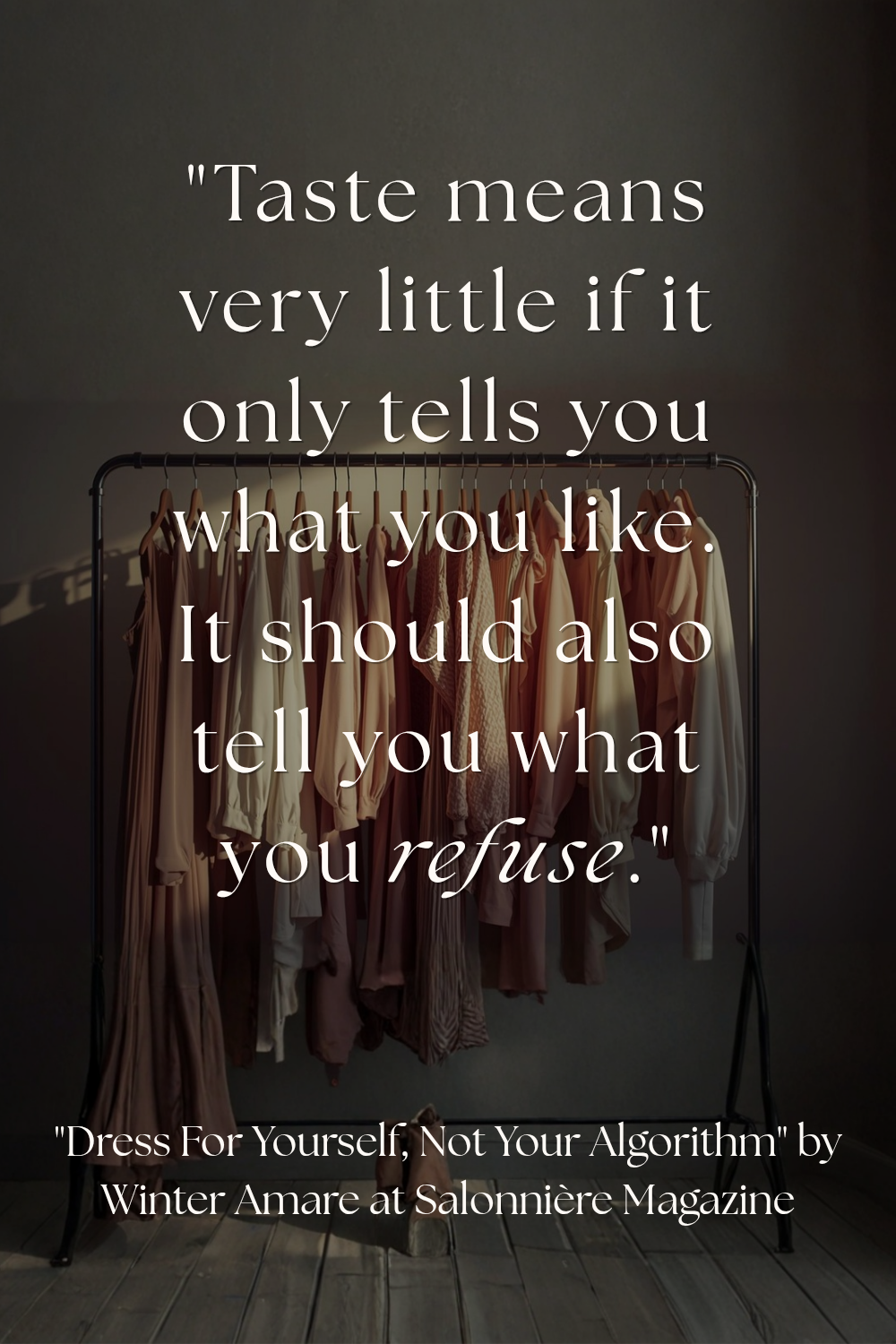
Taste means very little if it only tells you what you like. It should also tell you what you refuse.
There is a particular confidence in continuing to wear a piece after its moment has passed. Not because it is “timeless,” a word fashion uses far too freely, but because you still like it. Perhaps the jeans are no longer the favored cut or the bag has been replaced by another shape. If the item still belongs in your wardrobe, why should an invisible trend cycle be allowed to evict it?
This does not require abandoning the internet. The sheer amount of fashion available to us now is extraordinary. We can see runway collections almost immediately, discover independent designers from another country, browse vintage clothing from bed, and watch people in Copenhagen, Seoul, Paris, Tokyo, or New York interpret the same idea in completely different ways. There has probably never been a better time to be curious about clothes.
But access to everything has made discernment more important, not less. The challenge now is not finding inspiration. We are drowning in it. The challenge is developing enough confidence in our own tastes to ignore most of what is placed in front of us.
Use the internet as a source, not an authority. Take the color and leave the silhouette. Buy the sculptural jacket but ignore the trousers it was paired with. Wear a current-season shoe with a dress from ten years ago. Pull something forgotten from the back of your closet because suddenly you see it differently.
The point is not to prove that you are immune to trends. Nobody is. The point is to make them pass through your own judgment before they reach your wardrobe. Because an algorithm does not know your style. It knows your behavior. It knows what made you stop scrolling, what you clicked, what you watched twice, and what kept you on the screen for another thirty seconds. From that, it builds a version of you that is useful because that version can be predicted, categorized, and sold to. Personal style should be harder to predict than that.
Your wardrobe should contain things no recommendation engine would have thought to put together. It should carry old obsessions beside new ones, mistakes you somehow made work, pieces with histories, strange purchases, inherited things, and clothes you continue wearing long after everyone else has moved on.
The algorithm can keep guessing. It does not have to be right.
About The Author
Winter Amare is a published writer whose work encompasses a broad range of editorial and creative media, and has been featured by brands including L'Officiel. His cultural criticism is incisive, addressing fashion, history, folklore, and the balance between natural and digital worlds. Whether writing an essay or a story, he is oriented toward insight that holds more beneath the surface than first meets the eye.
Subscribe to Salonnière Magazine for full access to all articles & events!