Coyote Was There: The Messes We Make
They watched me from the desert wallpaper above my crib, caricatured like fluffy white bunnies, with soft edges and inquiring yellow eyes. When I walked home from friends’ houses at night, my parents warned me to be careful of them on the prowl. When our indoor cat went missing for more than a week, we knew they must have eaten her. At night, I heard them howling, yipping, even cackling incessantly to each other from the rolling grasslands beyond our backyard. Not at all like the silent Looney Tunes version I saw on TV.
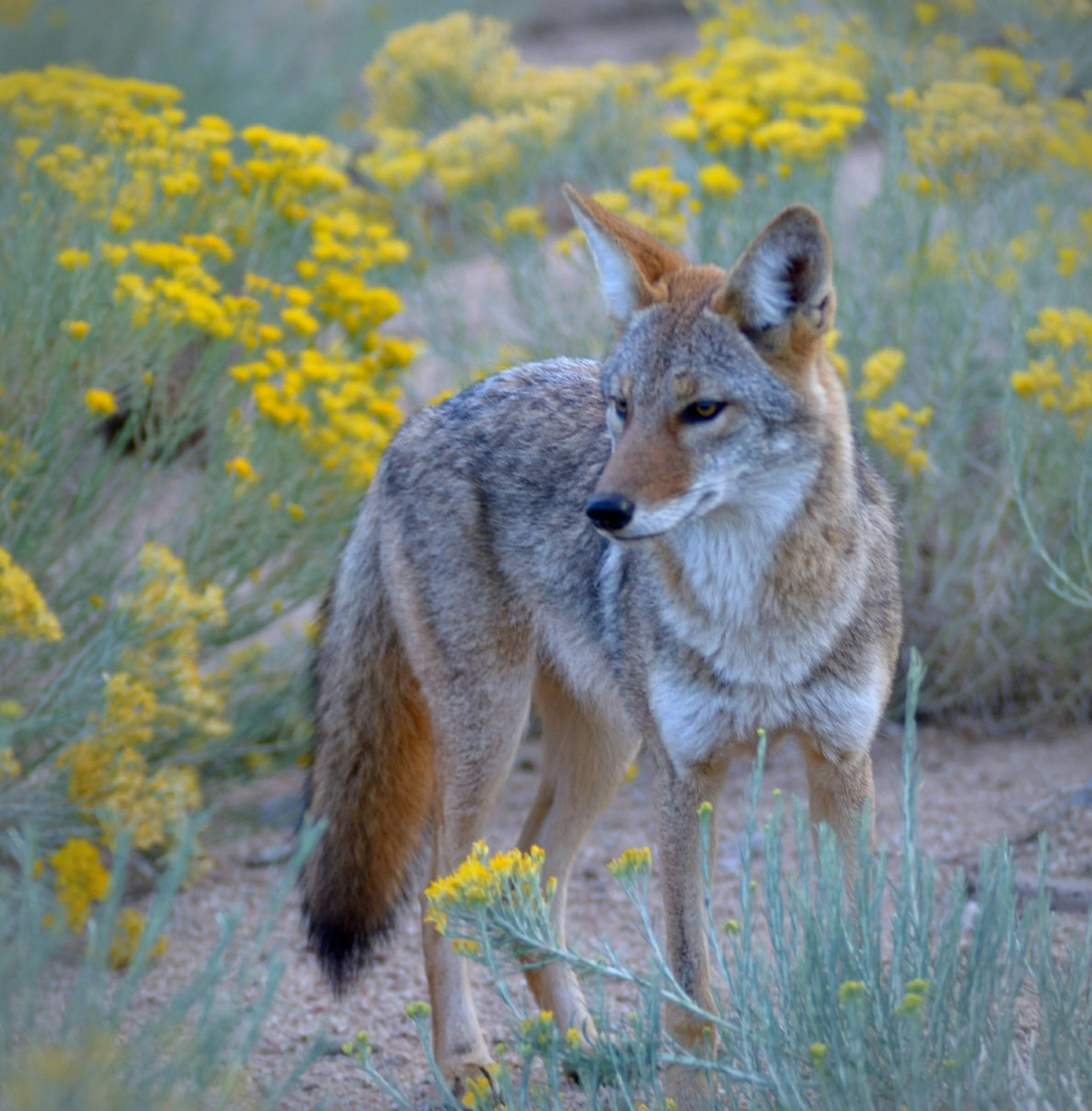
It wasn’t until well into my teens that I finally glimpsed one in person. Caught wide-eyed in the headlights of my mother’s van, the mottled gray canine sunk its head low and trotted almost weightlessly toward the safety of an irrigated planter. It was something of a disappointment, neither as cuddly nor as fearsome as the wallpaper or warnings had led me to believe.
Looking back now, Coyote seems like a constant presence in my exurban Southern California childhood, but that presence was never consistent. He could be a pet, threat, or butt of the joke—you could never get a clean read on him—but he was always there. When a wildfire tore through those hills and our houses alike, their howls returned within days, like us with our cameras, appraising the ashes.
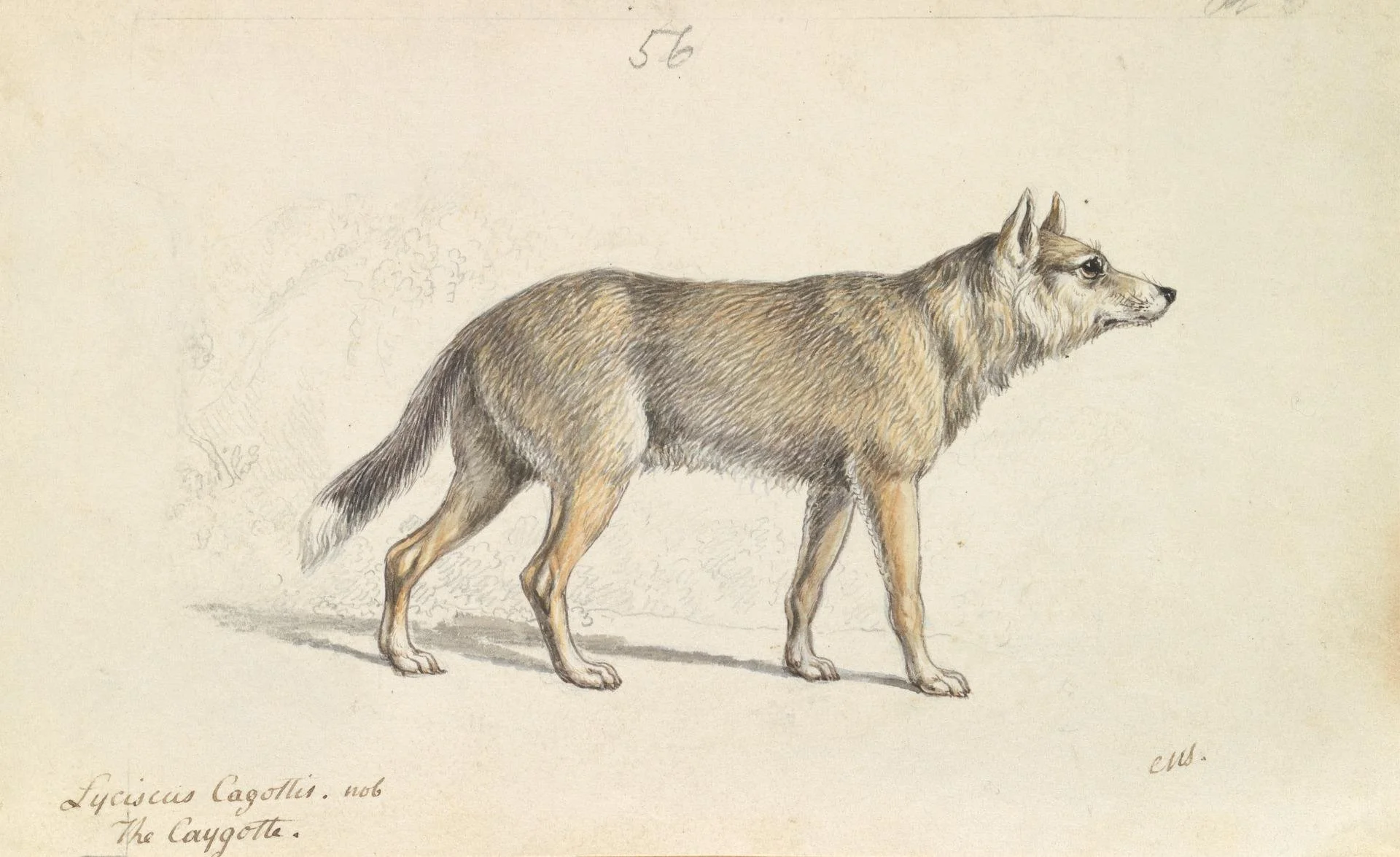
In 1872, as more and more Americans settled and attempted to “tame” the western frontier, Mark Twain described Coyote in his book Roughing It, as a “sorry-looking skeleton with a gray wolf skin stretched over it,” whose face “forever sags down with a despairing expression of forsakenness and misery… a living, breathing allegory of want.”
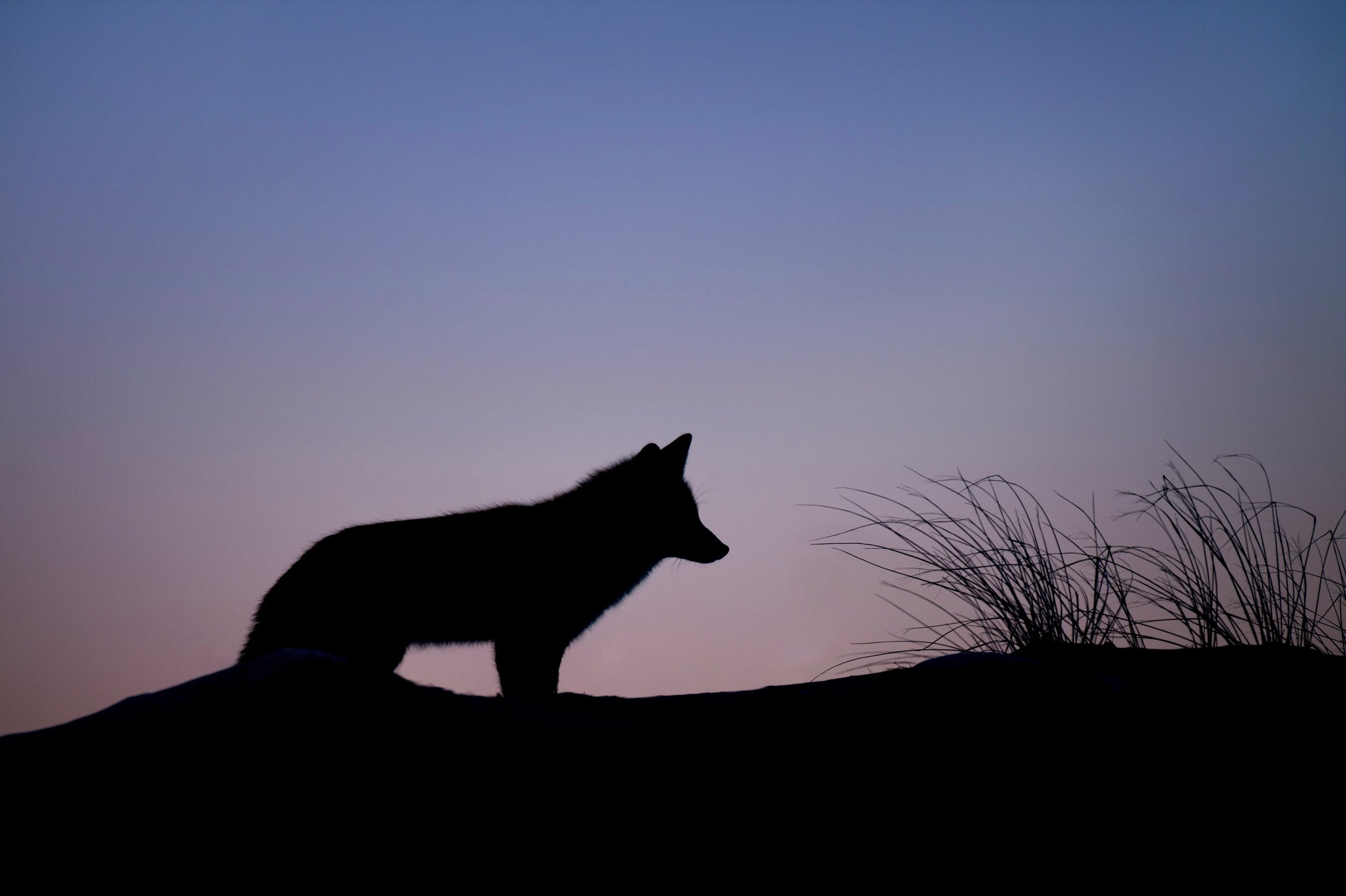
I wasn’t the first to underestimate Coyote. Far from an isolated opinion, Twain’s roasting of Coyote set the tone for settler relations with this mid-sized canine for the next century. By the 1920s, ranchers’ associations had persuaded the federal Biological Survey Bureau to let them wage a war of extermination against coyotes, as well as wolves and mountain lions.
When it came to wolves, the campaign was a rousing success, eradicating their populations from much of the contiguous US within a few decades. When it came to coyotes, not so much. All the bullets, traps, and poisons private and federal dollars threw at them couldn’t make a dent in the Coyotes’ population. Many were killed, but more bounced back.
What could account for Coyotes’ seemingly unkillable status? For one, unlike wolves, Coyotes aren’t apex predators, but mesopredators—mid-ranking predators, who were already used to being prey well before ranchers set their sights on them. For another, they’re amazingly adaptable and able to survive in seemingly whatever situation they find themselves in. They’ll eat what animals are available, live alone or in packs, and even switch from diurnal to nocturnal if it keeps them safer from predators or car traffic.
Most crucially, this adaptability extends to their reproductive behavior. When coyotes howl to each other across vast distances, they’re actually exchanging crucial information about how many of them there are in a given area—basically taking a census. And the results can trigger a hormonal change in females of reproductive age, readying their bodies to repopulate on command.
Thanks to all this, Coyotes have not only evaded human population controls; they’ve invaded our territory. From their original range mostly in the southwestern US, they’ve spread across the continent, from the Pacific Northwest to the Southeast, all the way down through Central America, in both rural and urban areas. Protection campaign signs posted in cities like Portland and Chicago remind us: Coyotes Live Here.
As with the rest of nature, most of us wouldn’t actively seek to exterminate them to comply with our economic interests. We may view them with at least a begrudging respect, borne of fear if nothing else, but perhaps they deserve more than that. Perhaps they deserve study, fascination, even reverence.
In an age of human-caused mass extinction, Coyotes stand (or skulk) in stark contrast to the norm. Many species’ human activities have decimated without even knowing. Coyotes endure.
While they remain a scourge to livestock and a trophy to sport hunters, it’s safe to say attitudes towards Coyotes have changed since Mark Twain’s time. What can these omnivorous, endlessly adaptable meso-predators teach us about our own evolving relationship with the natural world, about how and why the wild survives, even when relegated to the shadows of civilization?
For the answer, we must look backwards, before America was called “America.” We can look to the stories of the indigenous peoples, who look backwards even further, to before the Earth and stars were fixed as they are now.
It’s important to note that mythic stories about Coyote aren’t exclusive to one culture, nor the same between cultures. Coyote can play as many parts as there are people and places to interpret this rich animal archetype. There are undeniably undercurrents, but also disagreements.
William Bright’s compilation A Coyote Reader categorizes the stories by roles Coyote fulfills in each, like the Lecherous Old Man (who marries his daughter), the Glutton (who cooks his daughter), and the Thief (who steals fire). Among Wasco-Chinook traditions of the Northwest, Coyote is haphazardly responsible for forming features across sky, earth, and waters including the Milky Way, Big Dipper, Multnomah Falls, and the Bridge of the Gods over the Columbia River.
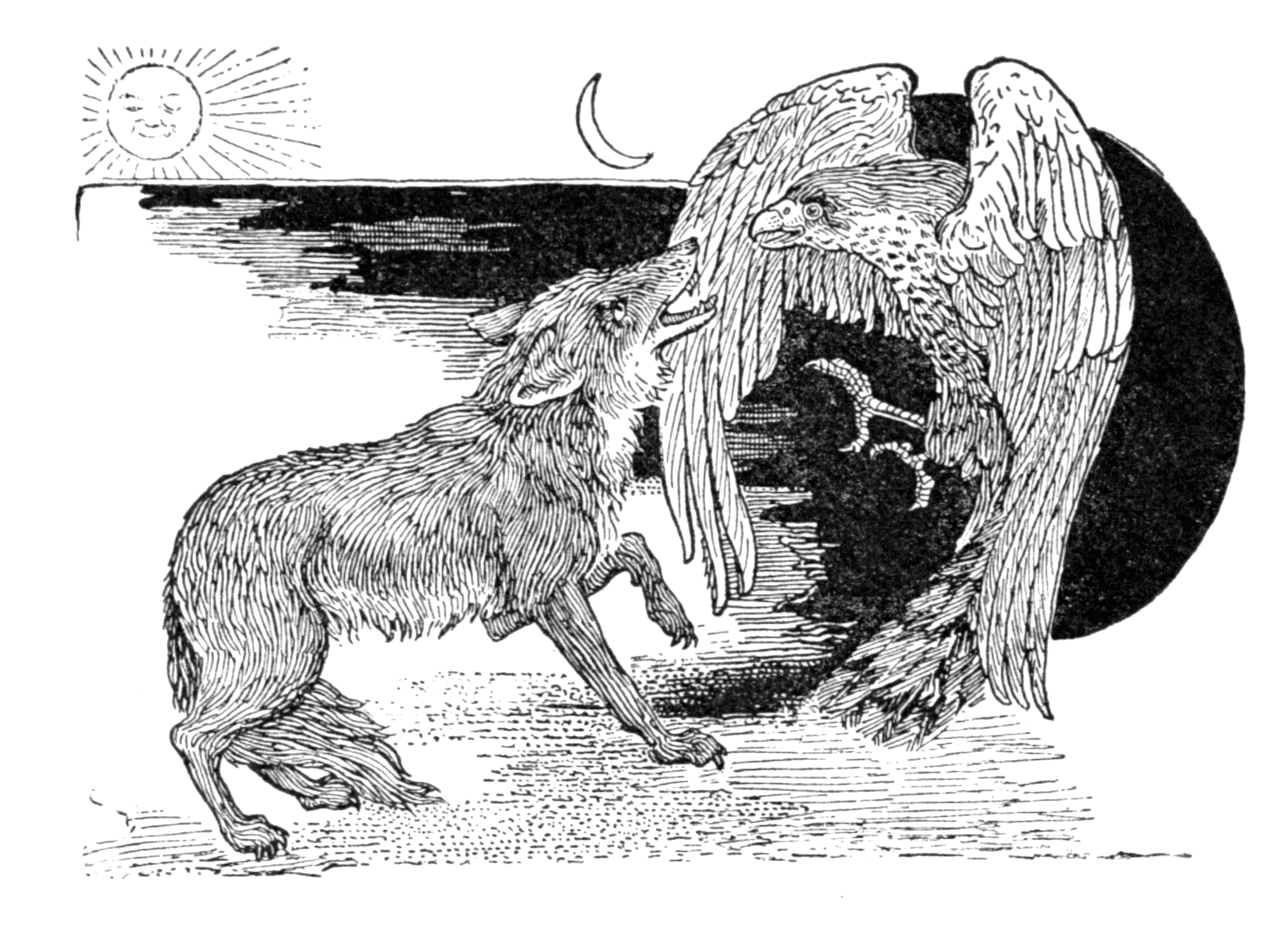
One of the most affecting tales, “Coyote and the Shadow People,” comes from the Nez Perce of Idaho. Coyote journeys to the underworld in an attempt to retrieve his dead wife with the help of a mysterious spirit guide. On his journey back, the spirit warns him not to touch his wife until clearing the last of five mountains, but when Coyote cannot help succumbing to the joy of having his wife back, she disappears in his embrace, and the chance for anyone to rescue loved ones from death is spoiled forever.
In this tale, we see how Coyote can act as a filter for human emotions and desires, explaining why the world is the way it is, despite our deepest wishes to change it. Sometimes his motives are shallow and self-interested. Sometimes they’re borne of the deepest sorrow and longing. Like Chuck Jones’s Wile E., the mythic Coyote can be pitiable and hapless, but each mistake he makes leaves monumental impacts. If he runs headlong into cliffs painted with tunnels, he makes mountains.
In the Navajo tradition, a nomadic hunting culture, Coyote, or Ma’ii, is among the most versatile and contradictory of all mythological characters. He can be funny, fearsome, greedy, foolish, cunning, low- or high-status—fittingly for a mesopredator. In contrast, stories of the Hopis, sedentary planters, almost always present Coyote as a “sucker,” who’s punished or killed for misdeeds like gambling and lechery, serving to forbid children from acting upon their trickster impulses from an early age.
In this contradiction lies the key to understanding how our perspectives on Coyotes, as with the rest of nature, tend to evolve. Coyotes link humanity’s wild past and domesticated present, representing those residual impulses members of agricultural civilizations must contain to uphold socioeconomic boundaries.
Lewis Hyde lumps the North American Coyote in with other “trickster” figures present in all strands of international mythology, from the thieving Hermes in the Greek pantheon to Loki among the Norse. No matter how hard laws or religions may try to exterminate the trickster, he’s always there.
Today, Coyote stories in Native traditions still thrive. Put into a modern context, Coyote satirizes and subverts the strange customs of Anglo-American culture, reflecting human experience. He could be razzing white anthropologists who trap him on the Rez, or seeing through an eloquent faux shaman on a college campus. Sometimes he’s of great significance; sometimes he merely shows up for the ride.
Perhaps Coyote’s resilience in the face of the attempted controls of Western Civilization can show us something about the relationship between our own conscious desires and the resistance of our subconscious wildness.
One of my teachers told me one of the most important things humans do for their environments is make messes. Even in trying to create order, we make messes, and in trying to clean up our messes, we make bigger messes, which eventually compound and give rise to unforeseen new orders.
In his introduction to Navajo Coyote Tales, Karl W. Luckert shows how our psyche distinguishes between the different animals, elements, and dimensions of reality by how much we believe we can control them. The scale goes from less-than-human, over which we can exert scientific control and experiment with; to the equal, whom we try to treat as we’d like to be treated; to the greater-than-human, where we experience fascination, awe, and surrender.
Perhaps Coyote is greater in power than we gave credit for. Perhaps the arc of Coyote’s treatment in Turtle Island reflects the follies of Indo-European imperial powers – to try to wrangle and control the nature of a foreign land, believing it to be lesser than our powers of religion and technology. Perhaps the wild nature we’ve tried to subjugate would operate better as a partner, or companion.
Perhaps the wisdom and awe we can experience through any animal or plant is proportional with the respect we grant it. While they may not look like much, the shapeshifting Coyote reflects a truth of our existence, like headlights in their wide eyes—all this is changeable. That may be a source of consternation and hope, depending on what angle you’re looking from.
About The Author
Jeffree Morel is a multidisciplinary writer, editor, and educator. He writes fiction, nonfiction, poetry, and screenplays with thematic interests combining ecology, mythology, and personal narrative.
His stories and poetry have been featured in publications such as the South Seattle Emerald, Weber: The Contemporary West, Tethered by Letters, F(r)iction, and Rabble Review. His blog is Foraging for More on Substack, and his first poetry chapbook, Ego Killers, is available in print and ebook. His screenplay In Your Dreams received the Oregon Literary Fellowship for the drama category in 2026, and he is currently working on his first full-length poetry collection, Breakup Flavors. He also offers contract copywriting and developmental editing services under the banner of Regenerative Writing.
Other than writing, he enjoys reading, drawing, jogging, singing, dancing, cooking, watching movies, practicing yoga, foraging for wild foods, spending time with loved ones, speculating on big questions, and acting weird to counteract the monotony. He is both a cat person and a dog person.