Reflections On The Substance
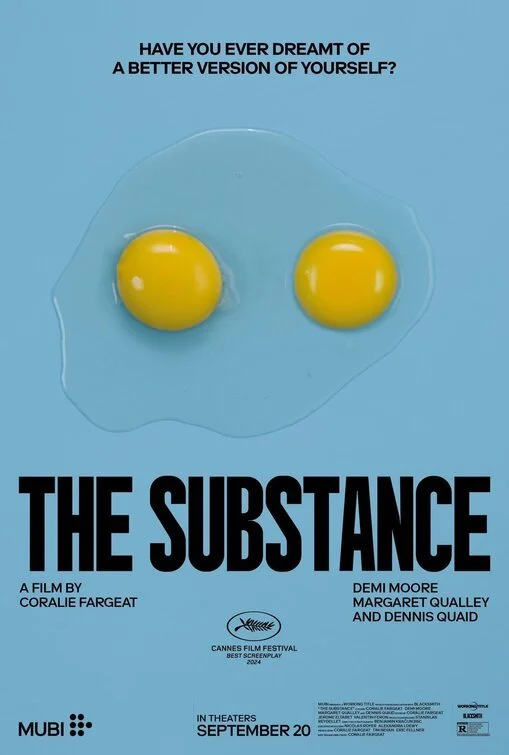
Two short reflections on the 2024 film The Substance.
#1
The Substance is a modern fairytale exploring the painful and isolating reality of aging as a woman in horrifying detail. Its distinctly feminine approach to storytelling sets it apart from other dystopian films; mood and myth drive the narrative, creating an immersive, unsettling experience. Silence dominates, dialogue is sparse, the image is everything.
Silence itself is feminine in contrast to the spoken word, which is declarative, explicit, and projects outward into the world. Words are a product of mental activity and convey meaning. Silence is full of mystery, the unknown, there is ambiguity as nothing is outright declared. Silence leaves space, a space that must be navigated by the body and the heart.
The Substance subjects the main characters and the audience to this feminine mode of communication, putting us in the feminine roles of receptivity and relationality. We are carried by an emotional current, allowed to observe events, and intuit their significance. Since connections must be drawn by the observer, a deeper relationship is created between the viewer and the film as our participation is necessary to make the film's meaning fully known/actualized. We are also more empathetic to Elizabeth as her limited dialogue ensures she is a blank slate; her silence creates space for us to project our own personal struggles with self image and the passage of time.
Intentional restraint with speech allows for more impactful communication via imagery and sound. Our sensitivity to tone is heightened, nearly every word feels jarring and intrusive. Lines spoken by male characters in particular underscore the masculine aspect of speech, they penetrate into the silence, disturbing the peace of every woman on screen.
The extreme close up shots of these men further the sense of violation. When Elizabeth's boss is using the bathroom or savagely eating a plate of shrimp, we are brought past our comfort zone to both watch and listen to the crass language spoken. Even milder scenes, such as Fred dropping his number in the mud, or the neighbor hitting on her beyond the door employ close ups to convey discomfort. Elizabeth's disgust is communicated by wordlessly placing viewers in her shoes. The imagery is first delivered without dialogue, generating a visceral reaction that is later underscored by words. By playing with visuals and proximity, our sense of touch is engaged and meaning imparted more strongly than words alone, since it was delivered in a way that invokes a primal response, bypassing rational faculties that mediate and weaken reactions.
#2
As a modern fairytale, The Substance combines elements from the entire body of Western folklore and mythology with science fiction tropes to create a multidimensional narrative that is universal and fantastical yet grounded by nihilistic materialism. When considering the story in light of the Creation narrative in Genesis, the parallels and inversions reveal important insights into the female experience.
Elizabeth Sparkle is the original creation. In an opening scene, we watch as her Hollywood Star (a pentagram, the symbol for man) is cemented into the ground, representing her coming into being, as her life is fueled by fame. Her star is ritualistically connected to her as an individual; at the height of her power, pedestrians celebrate the star, but as time passes her star is ignored and defiled, showing her growing irrelevance and ultimate bloody fate. The star, like Adam, was formed from the earth and Elisabeth, like Adam, is a representative of a collective that wields power over her domain.
Her apartment high above the city is an oasis, separate from the urban jungle, just as Eden is on the mountain, set apart from the wilderness. Instead of God, technology is the ultimate source of life and meaning within the world of The Substance. There is no spirit, just the cold gaze of the camera lens, broadcasting and immortalizing an image. And the substance is a quasi-magical, scientific stand-in for a potion that impersonally generates Sue.
God walks with Adam. When He creates Eve, he puts Adam to sleep in the Garden of Eden, opens him up and fashions Eve out of his bones. Elizabeth is offered the substance by a voice without a face and must inject herself while awake; she endures a painful internal process that culminates in a new woman bursting out of her back.
The differences between the two versions of creating Woman are glaring. Elizabeth's bathroom is sterile and cold. The impersonal, distant technology does not shield Elizabeth from pain, and by working covertly within her body actually amplifies her feelings of confusion and alarm, as she can only be passive, captive, to the disturbing activity going on inside of her body yet outside of her control. There is no love in this act, and no love follows between Elizabeth and Sue.
Sue's name brings to mind the Mary Sue trope - the perfect, seemingly untouchable character who glides through the plot with everyone's admiration. Saying her name requires pursing of the lips, which is highlighted repeatedly throughout her scenes, and speaks to her concentrated sexuality as even her name is charged with innuendo.
Like Eve, Sue represents the ideal woman of this universe. And as the creators of the substance stress, even though she and Elizabeth are two, they are still one, just as man and wife are one through marriage. Instead of a command to be fruitful and multiply, the technology of the substance empowers Elizabeth via Sue to render others impotent and isolated by captivating their attention through the screen and satisfying their lust virtually.
Sue's naked body receives excessive focus; both women spend many scenes naked, often self evaluating in the mirror or comparing while the other is unconscious. This is a direct contrast to the innocence of the nudity in the Garden of Eden, there was no awareness or self consciousness with Adam and Eve, only after the Fall do they feel shame and cover themselves.
Living fully for six days and switching on the seventh is a clear reference to the six days of Creation/work followed by the Sabbath which is reserved for rest. Before her Fall, Sue puts on a full leather outfit, all black with scales, becoming the serpent. In this outfit, she ignores the warnings and consumes the forbidden food on the 7th day. By violating the terms of the technology, she ushers Death into her world, and Elizabeth awakens first to a decrepit finger and eventually descends fully into a frightful old hag/Crone right out of a storybook.
The deliberate parallels between these aspects of the plot and the Creation and Fall in Genesis cause the story to have deeper resonance with the audience, as the familiar beats are accepted as a true pattern. By linking Sue with Eve, we gain more insight into her character. She is the perfect companion who becomes a temptress that ultimately undoes the entire Order. She was pure and pleasing but unsatisfied with her role; her curiosity and desire are her undoing.
The differences between both narratives are also revealing. In a world without God, where technology reigns, your physical body is both everything and nothing. It is the source of your self worth, the means by which everyone judges you, it is what you protect at all costs and sacrifice everything to preserve and enhance. But it is also just flesh, blood, and bones and can easily be left on a cold tile floor for days or dragged into a closet.
Elizabeth and Sue's empty, lifeless bodies don't actually mean anything within the universe. Even their living bodies only have significance to the degree that they are useful to others, it is entirely about consumption not truly considering someone as fully human. The question of identity and worth is central to the film. Genesis reveals that mankind is created in the image of God to serve as a mediator between Heaven and Earth. The Substance holds a mirror to the worst aspects of our culture, forcing us to consider what we are creating.